

You’ve Decided to Divorce. You Haven’t Decided What Comes Next.
Deciding to divorce doesn’t tell you how life afterward will work. The house, money, retirement, and parenting are connected decisions—not separate problems. Before you file, see how they fit together across two future households.

A New Way to Get Divorced: No Conflict. No Delay. No Billable Hours.
After 25 years solving complex strategy problems — and experiencing the traditional divorce system firsthand — David M. Irwin, Jr. built Divorce Architecture: a 30-day, fixed-fee process that replaces conflict, delay and billable hours with one complete plan.

Why Your Financial Advisor May Be More Important Than Your Attorney at the Beginning of a Divorce
Divorce decisions are financial long before they become legal. Your financial advisor already understands the financial life you are trying to protect and rebuild — investments, retirement, liquidity, risk and long-term goals. That perspective matters most before those decisions are locked into a legal agreement.

What Should You Organize Before Filing for Divorce?
Preparing for divorce is about more than gathering documents. The real work is understanding how finances, property, retirement, parenting and future household needs fit together before legal finalization begins.

Why Does Divorce Take So Long — and What Can You Do About It?
Divorce does not take months or years simply because families are complicated. Too often, fragmented decisions, repeated professional work and the traditional legal process create delay of their own. Here’s why it happens — and what can be done differently.

Alternatives to Traditional Divorce: What Exists Beyond Litigation, Mediation and Collaborative Divorce
Litigation is not the only way to divorce. Mediation, collaborative divorce, attorney-led negotiation and newer approaches each solve different problems. The key is understanding which process is best suited to build a resolution that actually works.

One Person May Start the Divorce. Both People Have to Live With the Resolution.
One spouse may find a better way to divorce before the other. That does not mean asking someone to accept an outcome—it means deciding together what operating model will be used to build the resolution.
Divorce Should Start With a Clear Plan, a Fixed Price, and a Defined End Point
Divorce should not begin as an open-ended process. Rainier & Hawthorne’s 30-Day Resolution Framework brings a clear plan, fixed price, and defined end point to the work of building a resolution architecture.

The Most Expensive Divorce Mistake: Solving One Problem at a Time
The house, retirement, debt, parenting and cash flow are not separate divorce problems. They are one interconnected transition. Solving each issue independently can create a resolution that fails as a system.

Divorce Architecture: A New Operating Model for Divorce
The divorce system starts in the wrong place. Divorce Architecture is a new strategy-first category that organizes and analyzes the financial, parenting, operational and practical dimensions of divorce before legal execution begins.

Where Do You Even Start? A Strategy-First Guide to Divorce
The house. Retirement. Debt. Children. Two incomes becoming two households. The first step should not be entering a process. It should be understanding the transition you are actually trying to build.

The Executive Guide to Strategic Divorce Resolution
Executives would never manage a consequential corporate divestiture through fragmented workstreams, open-ended economics and strategy developed on the fly. Divorce deserves the same discipline.

The Process Is the Risk: Why Traditional Divorce Can Destroy Value Before Settlement
Online forms, portals and automation have made pieces of divorce more efficient. They have not changed the operating model. The next disruption is not digitizing divorce. It is redesigning where the work of resolution happens.

Wealth Preservation in Divorce: Architecting Your Own Exit
A court does not manage your wealth. It fragments it. To preserve capital during a high-stakes transition, you must treat your divorce exactly as you would a corporate divestiture. Architect your own exit.
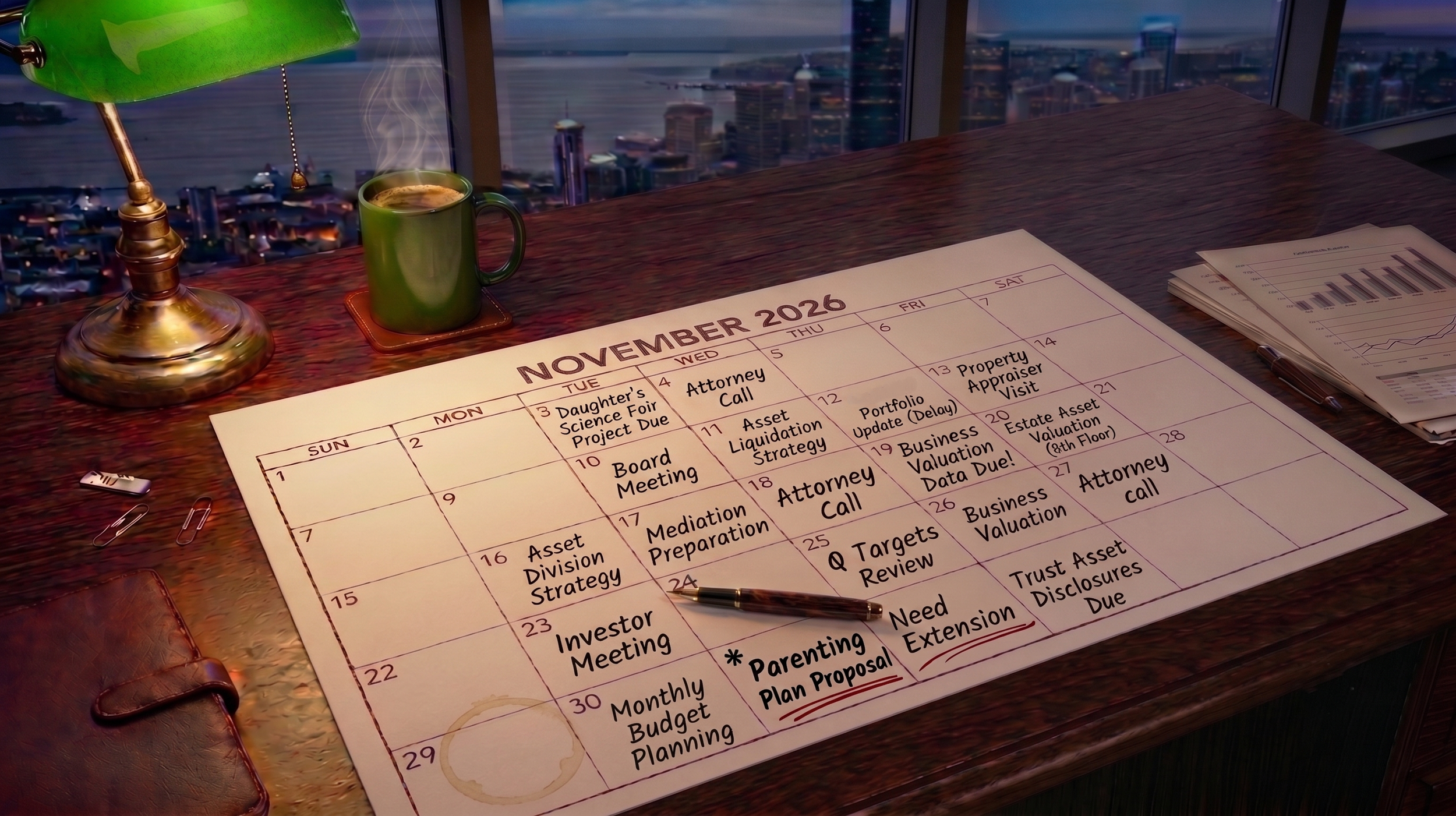
Why You Cannot Afford a 24-Month Divorce
The greatest cost of any crisis is the time wasted on indecision. In divorce, it only results in capital lost, more conflict, courtroom delays, and loss of control over the outcome. A family’s future simply cannot be protected while trapped in a 24-month litigation cycle. You cannot solve a structural problem with the same tools that created it. You need a data-driven blueprint for the future, not a prolonged public battle over the past. This piece details the structural flaws of the traditional system and the 30-day framework engineered to bypass it.

The Executive Blind Spot: Why Leaders Surrender Strategic Control in Divorce
Leaders demand information, accountability and disciplined execution in business, then often enter divorce through an open-ended process they would never tolerate professionally. That is the executive blind spot.

Beyond Litigation: Why Technology Alone Will Not Fix Divorce
Online forms, portals and automation have made pieces of divorce more efficient. They have not changed the operating model. The next disruption is not digitizing divorce. It is redesigning where the work of resolution happens.

Erasing the Friction: Why Divorce Needs One Decision Environment
The problem with fragmented divorce information is not merely inconvenience. It changes decision quality. Divorce Architecture brings financial, parenting and practical information into one coordinated environment so the transition can be understood as a whole.

The Compromise Trap: Why Equal Value Is Not Always Equal Economics
Two assets can carry the same stated value and produce completely different financial outcomes. Divorce Architecture looks beyond nominal equality to liquidity, taxes, income, risk and the way each asset functions after separation.

Why Delay Can Destroy Asset Value in Divorce
Markets move, businesses evolve, liquidity needs change and professional costs continue while a divorce remains unresolved. The strategic answer is not haste. It is disciplined velocity.